

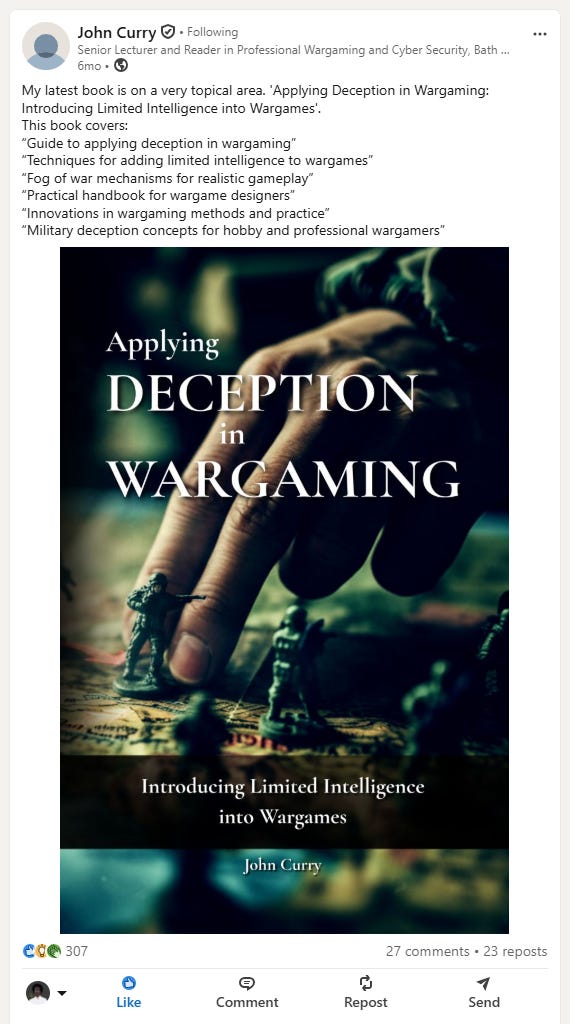
Earlier this year, I came across this post on LinkedIn by John Curry.
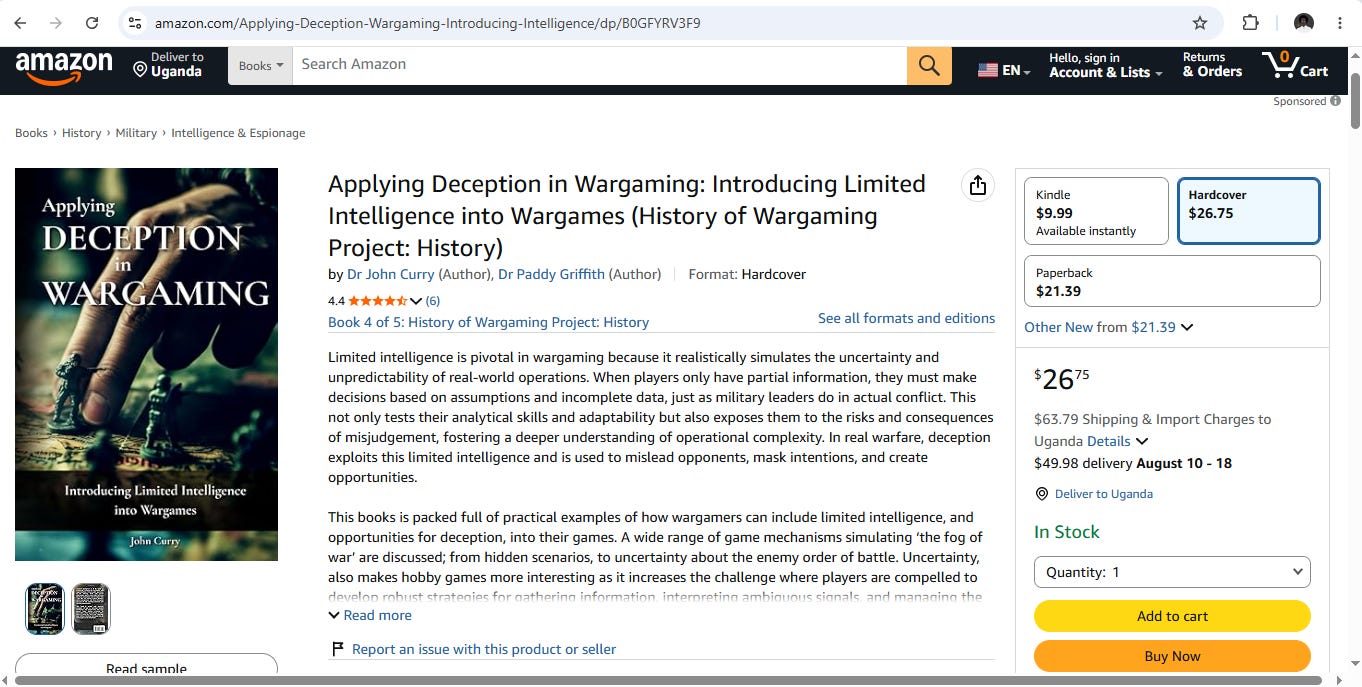
A few weeks later, I bought the book on Amazon (specifically the Kindle version).
A few weeks after that, I finally came around to actually reading it.
I was done reading it within one week.
SPONSORED:
In this pilot episode of This Week in Business Risk, Rwizi Rweizooba Ainomugisha hosts Lauri Tähtinen, the CEO of Mission Grey, to discuss what exactly external intelligence means, the future of human-machine teaming in navigating global corporate risk, and his childhood experience of eating a goat feast in Nairobi.
Wanna learn more about why Mission Grey is the leading provider of external intelligence for corporate decision-making? Book your demo today to see Mission Grey in action!
PS: You can use Stripe code ‘RWIZI’ to get a monthly $100 USD discount on your Mission Grey subscription
So, what do I think about the book?
I love it. It’s easy to read (the language is not too academic) and it’s packed with actionable insights on deception in wargaming that you can actually implement immediately as a wargame designer.
It’s basically a recipe book for deception in wargaming.
Every chapter explores a specific angle to deception/limited intelligence and then ends with a list of 3-7 game mechanics you can use to cover that angle in wargame design.
And at the end of the book, Appendix 1 is the Introducing Deception into Professional Wargames article by Stephen Downes-Martin (who John Curry credits for inspiring him to write the book).
Furthermore, Appendix 2 has a list of sample wargames with deception and the Bibliography on Deception has a list of great books about military deception.
So, in summary, go buy the book! It’s well worth every penny.
Also check out John Curry’s website, one of the top wargaming archives in the world.
What are my top take-aways from the book?
1. The definition of military deception
John Curry cites Stephen Downes-Martin who summarized military deception as:
1. condition the target’s belief, such that
2. the target changes their behavior, and
3. the deceiver gains an advantage
I had already come across this in Stephen Downes-Martin’s presentation at Connections UK 2024 (slides here and audio here) but it was great to get yet another reminder.
2. When not to introduce deception into a wargame
John Curry covers this right in the foreword.
“If one of the aims is to learn about a historical or current situation using a wargame, sometimes it is better to limit or even omit deception in the game”
3. The two types of deception
A-type deception (ambiguity-increasing) which aims to confuse the enemy by presenting multiple plausible options and M-type (misleading or ambiguity-decreasing) which seeks to convince the enemy of a specific false narrative.
Once again, I had already come across this in Stephen Downes-Martin’s Final Report of the Wargaming Deception Working Group but it was great to get yet another reminder.
4. The power of surprise
According to Christopher Lawrence of the Dupuy Institute, “surprise increases the chance of a favourable outcome by at least 50 percent” and according to the US Army Tactics field manual, “the easiest way to achieve surprise is to use deception”.
It’s intuitive to even the most basic military thinker that surprise is useful, it was great to get some solid numbers on how useful it is, as well as the link between surprise and deception.
5. Specific game mechanics for deception
As mentioned earlier, every chapter explores a specific angle to deception/limited intelligence and then ends with a list of 3-7 game mechanics you can use to cover that angle in wargame design.
These are the top 5 game mechanics that resonated the most with me (and that I will be looking to incorporate into my upcoming wargame designs):
· Dummy counters (Allow each side some scouting capacity to reveal some of these units pre-game. The more aggressive the recce, the more may be revealed, but the risk of losing the recce unit is increased)
· Require a complete set of pre-game orders that must be followed until the enemy are contacted (This one in particular reminded me of Battlegroup Clash: Baltics by James Buckley where the bulk of the game is in writing a sync matrix for your side and the rest of the game is just you playing it out as faithfully as possible. You can change your orders mid-game if necessary but it comes at a significant cost of time lost and electronic warfare emissions)
· Units that move faster stand an increased chance of being detected
· Fake orders that may be intercepted by the enemy
· Hidden combat strengths
Of course, shameless plug to a couple of my recent micro-wargame designs that feature A-type and/or M-type deception):
· Shadow Fleet, about Russia’s sanction-dodging oil tankers (the Russia player can confuse or mislead the West player about which delivery node they are aiming for)
· Iron Horse, about UGVs in the Russo-Ukrainian War (features dummy counters for mines)
Speaking of limited intelligence, no wargame delivers limited intelligence like the original wargame: Kriegsspiel.
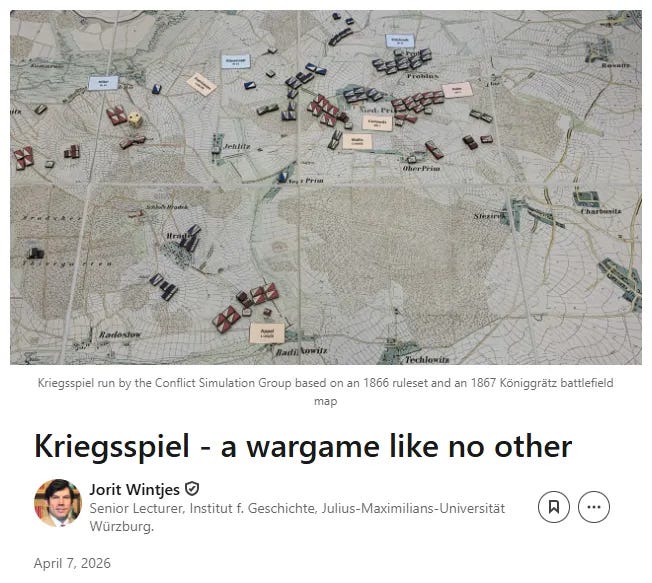
So on that note, I have to highlight the upcoming third annual Kriegsspiel Cup by the International Kriegsspiel Society (IKS). If you would like to participate, please reach out to James Horton on LinkedIn and/or join the IKS Discord.
And if you want to join my team in particular, just reach out to me on X, LinkedIn or Bluesky. No previous experience needed: just a thirst for decision-making, a hunger for victory… and a lot of luck!
You can check out my two previous attempts at Kriegsspiel here and here if you want to know what kind of team-mate you’ll be signing up for.
SUPPORT THIS NEWSLETTER: You can now support Wargaming Weekly on Patreon for as little as $5 per month! SPECIAL SALUTE to my first top-tier patron: Christopher Nordahl

Wait! What’s hiding in that Fiction Corner?
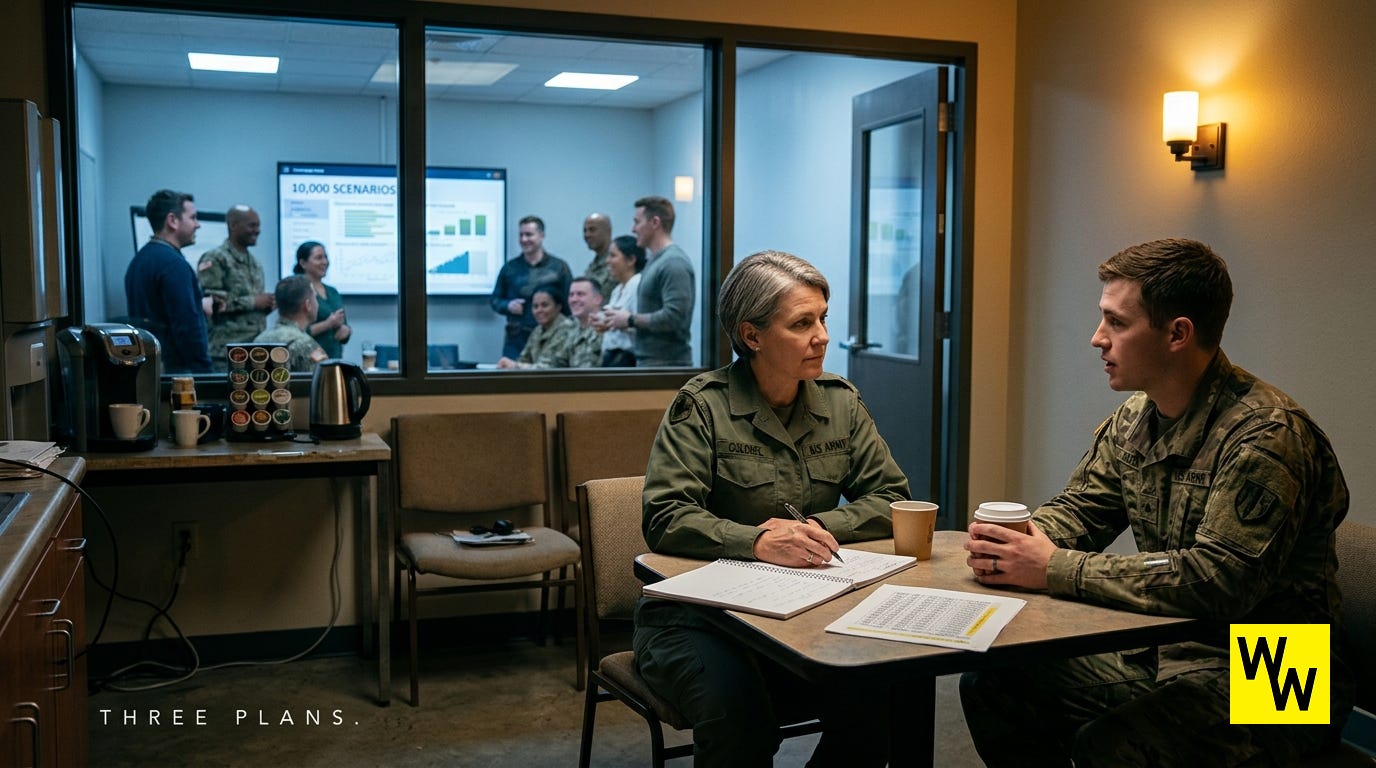
Colonel Diane Beaumont has won the Chairman’s Award for Planning Excellence twice and she watches the APL platform generate 10,000 plans and knows they are good, and she also knows something about plans that the platform cannot know — something she learned in rooms, from watching faces, over 20 years — and she has no intention of saying it until someone asks the right question.
The right question arrives from a logistics major she has never met, at a coffee station, 8 minutes after the demonstration ends. He asks: the plans are good, but who briefs them? She looks at him for a moment and asks if he has seen this before.
What he tells her happened in Mosul in 2017, and she has been carrying the same knowledge from a different direction for 20 years, and neither of them has ever been in a room where the institution was ready to hear it.
Read the full story on Patreon (available to both free and paid subscribers).
Lastly… what’s that over there in the Business Corner?
This Joe Budden interview.
His podcast has brought me so much laughter during my lunch breaks.
I’d love to replicate even just 1% of his Patreon success… help me get there!
Yours in hex,
Rwizi.
ABOUT THE AUTHOR:
Rwizi Rweizooba Ainomugisha is a freelance wargame researcher, analyst and designer. With a background of over 10 years in the B2B marketing and fintech startup spaces, Rwizi is also building Social Funds, the gamified social finance app designed to help young Ugandans budget, save, and fund their goals together.

you asked whether it's the most important wargaming book of 2026 — I had a go at answering from the hobby side:
https://bigboardgaming.com/important-to-whom-deception-and-the-wargame-that-cant-deceive-you/